Category Archives: Sounds
Sensuous Psychogeography
Featured
1
What kind of knowledge is disclosed when one navigates a city with the nonvisual senses? Developing the practice of sensuous psychogeography, I explored how these senses might spark different personal, social, and political resonances over multiple passages through Ōtautahi Christchurch, New Zealand. I hoped this would reveal what could otherwise remain literally overlooked in the regular patterns of experience in our visually dominated society.

Over three months I set out on multiple sense-focused walks in which the visual was subordinated to our other senses. This reversed the usual sensorial mode used to move around the city, and was guided by non visual cues that emerged. These could be an intriguing sound far away of close at hand, following a breeze, homing in on a smell, or – as in the walk led by forager, Peter Langlands – led by the wild foods growing in the city’s streets. I called this method, sensuous psychogeography.
Sensuous psychogeography is a new method of creative enquiry, and means of encouraging people to make different, and perhaps deeper connections with their local urban spaces. This draws on the Situationist idea of psychogeography. In his Introduction to a Critique of Urban Geography, Situationist, Guy Debord, defines psychogeography is “the study of the precise laws and specific effects of the geographical environment, consciously organized or not, on the emotions and behaviour of individuals,” (Debord,1955). It was concerned with the urban environment’s psychological effects, challenging the capitalist system through creating actively lived situations to counteract passive image-dominated consumer culture. Sensuous psychogeography particularly embraces the Situationists’ critical walking practice, the dérive (drifting), a playful exploration of urban space that redirects pedestrians away from well-trodden paths to alter awareness of their environments.

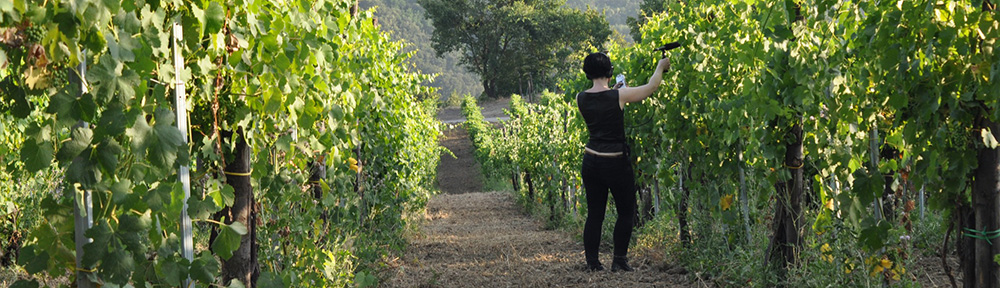
Sensuous psychogeography also emerged from the creative research of my recent arts PhD. In this I investigated the aesthetic and emotional dimensions of sensory interactions and how these related to place, both imagined or real. For example in my Risonanze di Vino project, I investigated how the nonvisual senses of winemakers connected them to both their product and the land their grapes were grown on.
As an artist who previously made works responding to the changing environments of Christchurch during the destructive earthquakes over a decade ago and their aftermath, I sought to re-engage with the city’s current unique phase of urban transformation after recently returning from four years overseas. The city’s recent challenges have seen its inhabitants repeatedly forced to diverge from familiar paths due to natural and human disruptions, which resonates with psychogeographical techniques.
The ongoing COVID-19 outbreak has also seen residents living much of their lives on screens, some affected by a lingering unease about re-entering urban spaces. This makes a method that encourages such sensory immersion both challenging for some, but also liberating as articulated by a number of those who participated in walks with me.


These sensory excursions took many forms. Some were undertaken alone, sometimes gathering materials en route that I would then use to create the project’s final works. These ranged from the sounds that I recorded, fragrant plants I went on to distil, as well as textural objects, and included following the nonvisual elements of the Ōtākaro Avon River from the city to its mouth at the Pacific Ocean (pictured above). I drifted with individuals from the fields of urban ecology and planning, architecture, music and foraging. I also meandered with members of the public, local iwi and the blind and low vision community.

All the discoveries made were expressed through the project’s ultimate multisensory artworks that I created. These use interactive combinations of sound, olfaction, taste, and touch to answer the central question posed by the project, “What might we find when we stop looking?”, also the name of the exhibition which runs at The Arts Centre Te Matatiki Toi Ora, Christchurch, New Zealand between 18-29 May, 2022.
This project was undertaken during Te Matatiki Toi Ora’s 2021 Arts Four Creative Residency Programme between May-July 2021. It was, supported by Creative New Zealand and Stout Trust, and proudly managed by Perpetual Guardian. Scented support from Fragrifert and Fragranzi.
Risonanze di Vino – book published
Featured
 Risonanze di Vino:
Exploring the Sensory Terroir of Rural Italy
Editor: Jo Burzynska
Contributors: Jo Burzynska, Gaetano Carboni, Leandro Pisano
Publisher: Interferenze Book Series
Risonanze di Vino, a book documenting two of my wine and sound projects in Italy, has now been published as part of the Interferenze Book Series and is available to purchase here.
About Risonanze di Vino
Risonanze di Vino explores the multiple connections made through a series of artist residencies in rural Italy that unite the senses, culture, and nature, as framed within discussions of the Anthropocene. It documents the residencies – conducted as creative sensory research – through which the multisensory artist Jo Burzynska, identifies and tunes resonances between sound and wine through an interlaced sensuous system that she calls sensory terroir.

Credit: Daniela d’Arielli / Pollinaria
Organised by the Interferenze art research platform in the Irpinia and Sannio regions, and the Pollinaria agricultural residency programme in Abruzzo, the projects were oriented by the artist’s immersions in cultural and personal sensory experience within these agrarian environments. The residencies resulted in sense-focused artworks in which soundscapes – created from field recordings of the winegrowing environments – play in crossmodal harmony or conversation with the local wines.
 The projects are contextualised within current discourse around the Anthropocene through the curatorial contributions from Interferenze’s Leandro Pisano and Pollinaria’s Gaetano Carboni. If the Anthropocene is a sensorial phenomenon, sound art could be well placed to expose symbiotic coexistences and initiate resonances that shift perceptions.
Taste the Bass
Featured
Want to boost the body of your Pinot Noir, then turn up the bass!
The latest paper from my  current doctoral research exploring the sensory and aesthetic interactions between wine and sound has been published in Multisensory Research. The product of a great project that involved Professor Charles Spence and Dr Janice Wang at Oxford University’s Crossmodal Research Laboratory, with input from my co-supervisor at the University of Adelaide, Associate Professor Sue Bastian.
Taste the Bass: Low Frequencies Increase the Perception of Body and Aromatic Intensity in Red Wine
The Constellations Podcast
 Jo Burzynska and Professor Anina Rich were interviewed about the Osmic Resonance project by Bec Dean for The Constellations podcast series. This episode of the series exploring art projects that operate at the intersections of science and technology can be accessed through the link above or on iTunes.