BOOKS

The Sensory Terroir of Crossmodal Art explores how our senses converge in making and experiencing art. It introduces crossmodal art as a new category of creative practice blending multiple senses. Drawing on the interconnectivity of wine terroir, the book provides a non-hierarchical framework for navigating multisensory aesthetic experience, from immersive art to wine tasting.
This innovative, interdisciplinary volume bridges the fertile experiential and theoretical fields of art and creative practice with contemporary scientific understandings of crossmodality in psychology, neuroscience, and sensory science. It focuses on crossmodal art created at the nexus of hearing with taste and smell – senses often excluded from definitions of art. Case studies reveal correspondences between sounds – from music to field recordings – and the culturally rich yet aesthetically contested sensory experience of wine. From these, the book develops practical and adaptable tools, which include sensory mapping systems and contemplative techniques that readers can use to both conceptualise multisensory experience and create crossmodally.
The Sensory Terroir of Crossmodal Art is relevant to scholars of sensory studies, art and aesthetics, sound studies and musicology, design, museology, anthropology, psychology, and neuroscience, as well as wine, food, and marketing researchers. It will also be of interest to artists and musicians, curators, experience designers, brand strategists, and drinks and hospitality professionals who wish to employ evidence-based, non-visual multisensory methods.

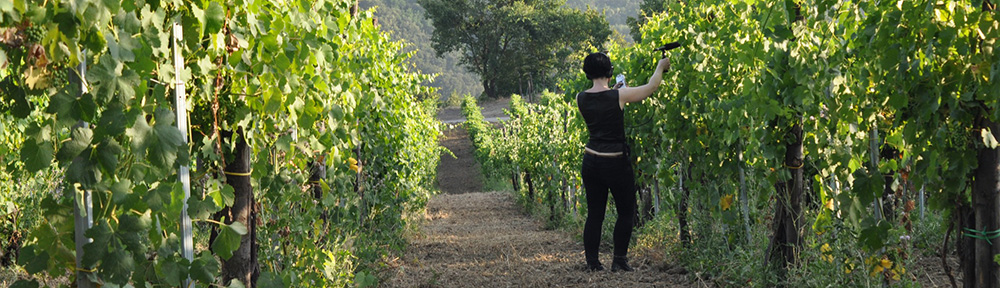
Risonanze di Vino explores the multiple connections made through a series of artist residencies in rural Italy that unite the senses, culture, and nature, as framed within discussions of the Anthropocene. It documents the residencies – conducted as creative sensory research – through which the multisensory artist Jo Burzynska, identifies and tunes resonances between sound and wine through an interlaced sensuous system that she calls sensory terroir. Organised by the Interferenze art research platform in the Irpinia and Sannio regions, and the Pollinaria agricultural residency programme in Abruzzo, the projects were oriented by the artist’s immersions in cultural and personal sensory experience within these agrarian environments. The residencies resulted in sense-focused artworks in which soundscapes – created from field recordings of the winegrowing environments – play in crossmodal harmony or conversation with the local wines. The projects are contextualised within current discourse around the Anthropocene through the curatorial contributions from Interferenze’s Leandro Pisano and Pollinaria’s Gaetano Carboni. If the Anthropocene is a sensorial phenomenon, sound art could be well placed to expose symbiotic coexistences and initiate resonances that shift perceptions.
SOUND
TRAINS IN TROUBLE: AN INTERGENERATIONAL JOURNEY IN LOCOMOTIVE LISTENING. Ilam Press. 2024.
- Erewhon Calling
- Pauline Oliveros – Five decades as a deep listener by Jo Burzynska
- Stanier Black-Five interview
- The Sound of Steam by Jo Burzynska
- The sweet rhythms of Italy’s vineyards
- The Wire magazine: Global Ear column on Christchurch
WINE
- Wine Class: All you need to know about wine in New Zealand. Random House. (2009)
- NZ Herald/Viva columns (2007-present)
- Assessing Oenosthesia: Blending wine and sound. International Journal of Food Design. (2018)
- The root of all Shiraz. Club Oenologique Magazine. (2019)
- Scientists prove regional variations in yeast. Decanter.